




Small Hours Press

Red in the face, fists clenched, knees pulled up to the tummy. The crying comes back in the afternoon and evening, and the baby is hard to settle.

Those are signs the NHS lists for colic — the same source this guide cites on page 19. Inside: eighteen everyday situations with a crying baby, one page each. What to notice, what to do next, what to bring to your baby's health care provider. Thirty pages, twenty-nine named sources.

A parent holding a crying baby.
  • 18everyday situations
  • 2practical steps each
  • 30pages
  • 29named sources

Do you recognize any of this?

  • Crying that is hard to soothe or settle.

  • Clenched fists. A face gone red. Knees brought up to the tummy, or a back that arches.

  • Crying more often in the afternoon and evening.

  • A tummy that rumbles, or a baby who is very windy.

  • More than 3 hours a day, 3 days a week, for at least 1 week — in a baby who is otherwise healthy.

  • And the part no list covers: the crying comes back after the feed, after the walking, after the thing that worked yesterday.

The NHS lists the first five as signs that a baby may have colic. A list is not a diagnosis, and neither are your notes. All of it is worth writing down.

Everyone tells you it passes. Nobody tells you what to write down in the meantime.

It is not for you if:

  • You want a diagnosis, a dose or a cure. Page 22: "This guide does not provide doses or tell you to stop a current prescription."
  • You want teas, drops or burping techniques. Page 19: "Do not use tea, juice or water instead of milk to treat colic."
  • You need help right now. Page 4 comes first: "Get help before trying a practical step."
Eighteen situations. Two practical steps each. Thirty pages. Twenty-nine sources.

The sources are named and numbered S01 to S29 on pages 27 to 29: NHS, Health Canada, the Canadian Paediatric Society, the CDC, the American Academy of Pediatrics, ESPGHAN, the FDA, and named PubMed records. Each situation page also prints, at its foot, the sources behind that page.

Four real pages, before you decide

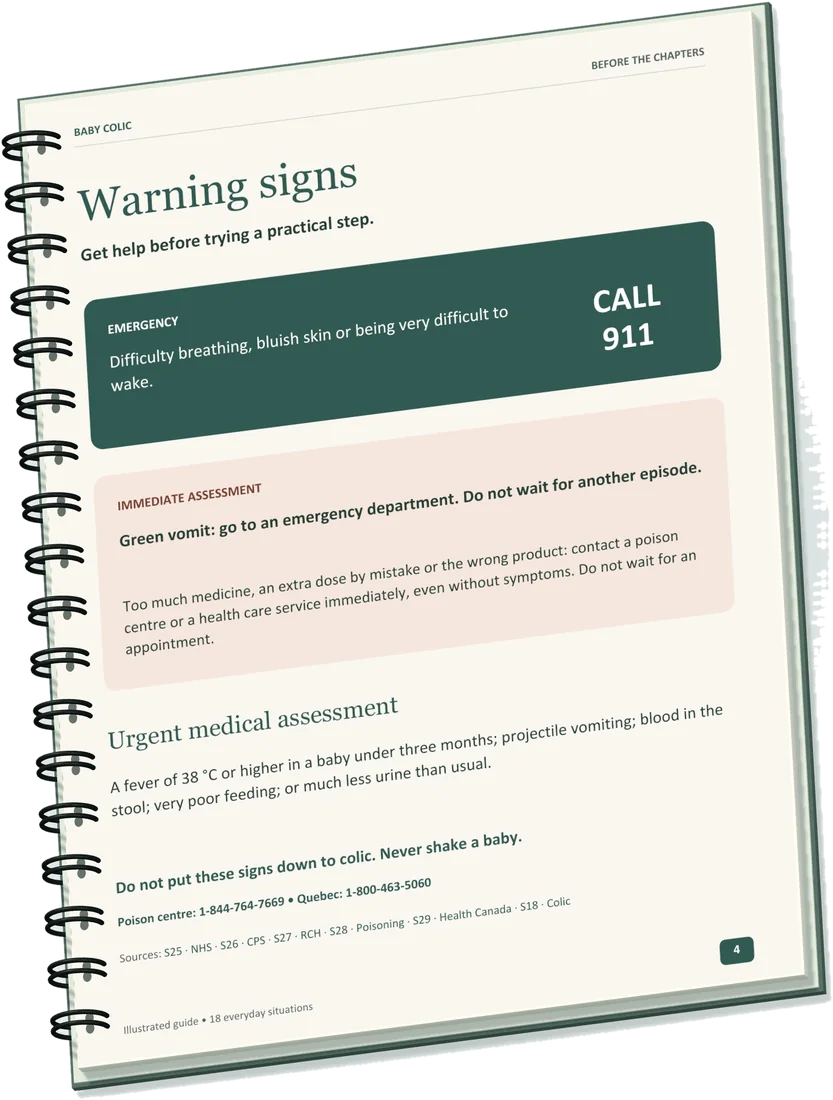
  • Page 4 of the guide: warning signs and Canadian poison centre numbers.

    Page 4 — Warning signs, before the chapters. What it settles: which signs are not a guide's business at all. One line runs across the top — "Get help before trying a practical step." — and the Canadian poison centre numbers are printed there, including the Quebec line.
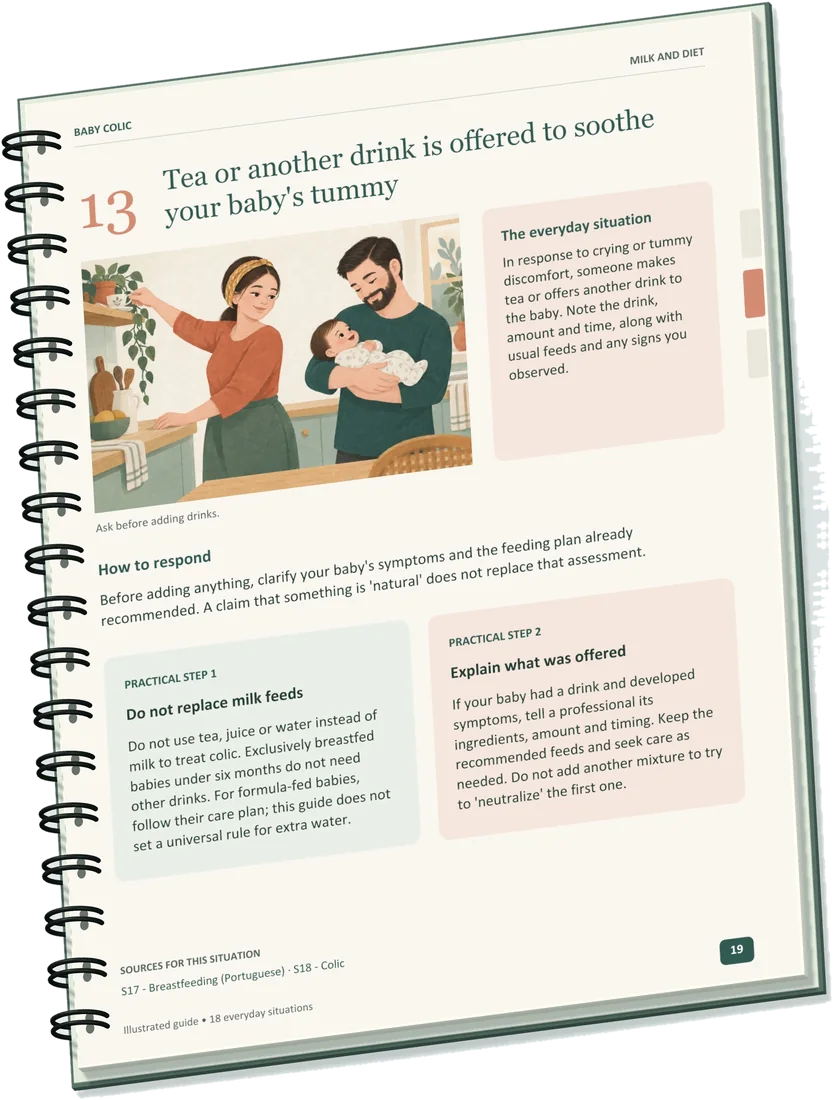
  • Page 19 of the guide: a drink offered to soothe the baby, with two practical steps.

    Page 19 — "Tea or another drink is offered to soothe your baby's tummy." What it settles: the drink someone is about to make. "Before adding anything, clarify your baby's symptoms and the feeding plan already recommended." And: "Do not use tea, juice or water instead of milk to treat colic."

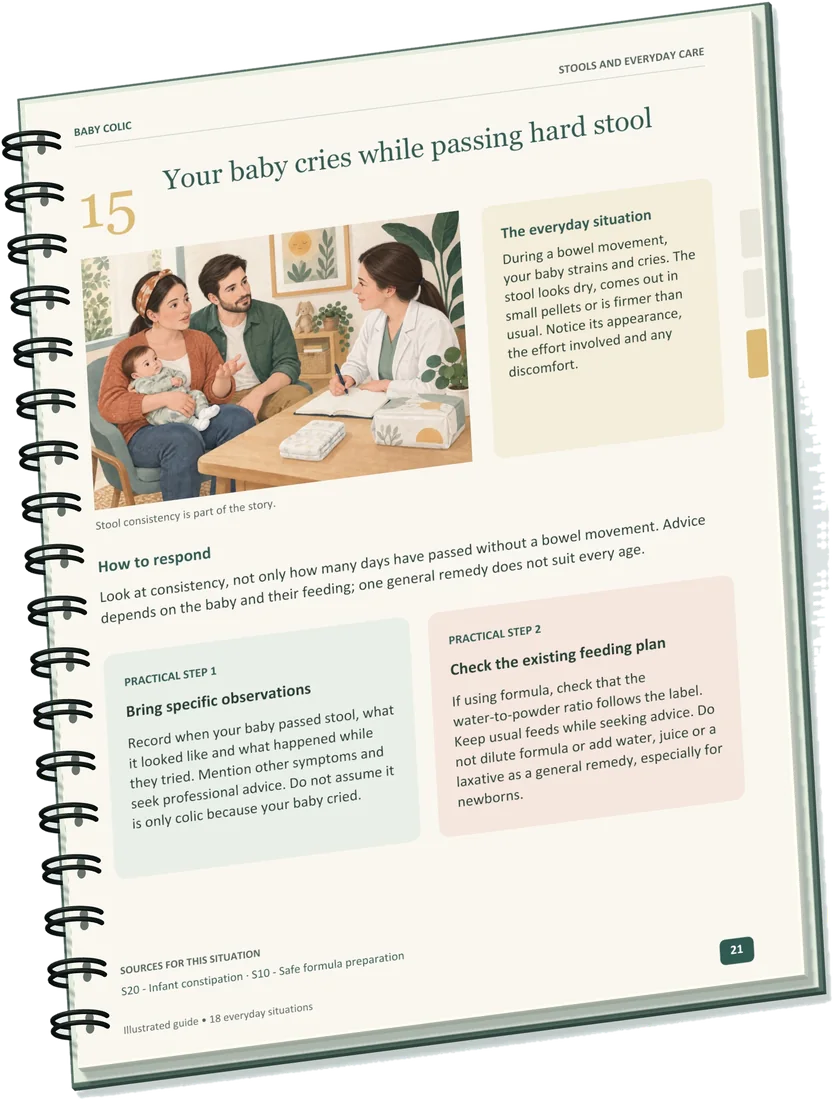
  • Page 21 of the guide: crying while passing hard stool.

    Page 21 — "Your baby cries while passing hard stool." What it settles: the conclusion you are tempted to jump to. "Do not assume it is only colic because your baby cried." Instead: record when your baby passed stool, what it looked like and what happened while they tried — and "Look at consistency, not only how many days have passed without a bowel movement."

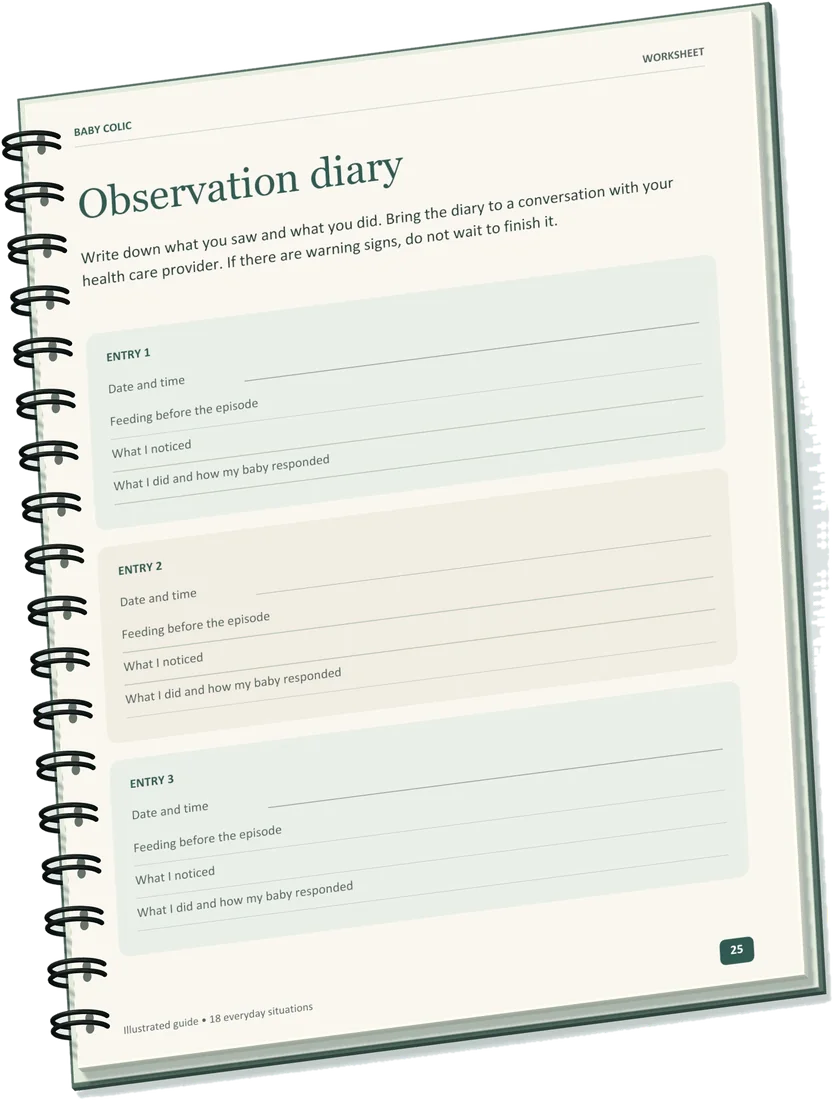
  • Page 25 of the guide: the observation diary.

    Page 25 — Observation diary. What it settles: the appointment. Date and time. Feeding before the episode. What I noticed. What I did and how my baby responded. "Bring the diary to a conversation with your health care provider."

It starts in the afternoon, and it is never one thing.

A face gone red. Fists clenched. Knees brought up to the tummy.

You rock. You walk. You try a feed. You hold your baby upright and wait. The crying comes back.

By the weekend someone has cut beans and cabbage out of their meals. Someone else has made tea. Somebody has suggested drops, and you are not sure whether they were already given tonight.

Everyone tells you it passes.

Nothing is written down. Both arms are busy.

Then the appointment comes, and the only sentence you have is: they cry all the time.

Here is what changes.

This guide does not tell you what is causing the crying. It tells you what to notice, what to do next, and what to bring to the person who can assess it.

You open the one page for the situation in front of you. You read what to notice. You do the two practical steps. You write down the date and time, the feed before the episode, what you noticed, what you did and how your baby responded.

At the next appointment you do not bring "they cry all the time". You bring dates, what happened and when it started, what was already given — names, strengths, amounts and times — and the questions you want answered.

Your notes are observations, not a diagnosis. That is exactly what an assessment is built on.

The usual move, and what the page asks instead

  • Another brand of formula, because the crying came back. Page 13 asks instead: put the history in order — which formulas were used, when they changed and what you noticed — and separate the observation "cried after a feed" from the conclusion "this formula caused colic". Crying alone does not show which formula, if any, is needed.

  • Another food off a breastfeeding parent's plate, after the baby cries. Page 17 asks instead: keep a varied diet that respects your own needs and professional advice; if the family notices a repeated pattern, write down what happened and discuss it with a professional. The record supports assessment; it is not evidence that a parent is to blame.

  • Tea for the tummy, because it is natural. Page 19 asks instead: before adding anything, clarify your baby's symptoms and the feeding plan already recommended. "A claim that something is 'natural' does not replace that assessment."

  • One more dose of drops, because the crying came back. Page 22 asks instead: check what has already been given. "Continuing crying calls for reassessment, not an automatic increase in medicine."

  • A probiotic, because colic is assumed to mean a lack of good bacteria. Page 23 asks instead: discuss with your baby's health care provider whether a probiotic is appropriate and which strain has been studied for that situation. "The word 'probiotic' on a label does not establish an individual need."

Problems along the way

  • Reading "lactose-free" as a treatment for the crying. Page 16: "'Lactose-free' does not mean 'colic treatment' or a formula suitable for milk allergy."

  • Deciding it is only colic because your baby cried. Page 21: "Do not assume it is only colic because your baby cried." Page 20: "Crying during a bowel movement alone does not establish a diagnosis."

  • Using a thermometer, a cotton swab or a tube to trigger a bowel movement while comforting a crying baby. Page 20 asks you to avoid that, and: "Do not use laxatives on your own."

Whenever this happens, the guide asks for that

  • Whenever the crying arrives with changes in stools, skin or alertness → note what your baby was fed, the time until symptoms began and what happened. (page 15)

  • Whenever someone offers the baby a drink for the crying → note the drink, amount and time, along with usual feeds and any signs you observed. (page 19)

  • Whenever a product is given because the crying returned → record the product, dose, time and who gave it. (page 22)

The studies, with the guide's own limits printed beside them

  • S02, one of the two sources on page 7: "Study of 43 babies; generalizability is limited."
  • S14, a maternal diet trial: "Study of 13 babies; it does not test individual foods."
  • S16, a maternal caffeine study: "Not used as proof that caffeine causes colic."
  • S24, on paternal smoking and excessive crying: "Cross-sectional design; it does not establish a cause of diagnosed colic."
  • S06 is a randomized trial on burping and colic, and page 11 draws one line from it: "Burping does not have to become a task that only ends with a sound, or proof that a feed went well."
  • And at the foot of page 29: "Small and observational studies do not establish a general cause of colic."

Here is what you walk away with. The situation in front of you, named and on one page. Two practical steps for it. A record of what you saw and what you did. And the questions worth asking, in an order your baby's health care provider can use — these details help guide the assessment.

What you get — CAD $19

  • The full guide as a PDF: 30 pages, 18 × 24 cm, Canadian English edition 1.0, September 2026.
  • 18 situation pages, with two practical steps each (pages 7 to 24).
  • Warning signs and the Canadian poison centre numbers (page 4).
  • The observation diary (page 25) and the appointment worksheet (page 26).
  • Every source, S01 to S29 (pages 27 to 29).
  • A "3D book" version in HTML, to read in a browser.

One payment ofCAD $19.A digital download — nothing is shipped.

What CAD $19 actually buys: the work of putting eighteen everyday scenes with a crying baby in order, one page each, with the sources printed on the page. Every one of them is named on pages 27 to 29 and you can look them up yourself. What you are not doing is that reading at 2 a.m., with one arm free.

The two practical steps are educational. In the guide's own words: "They are not a required sequence or a promise of relief."

7 days. If this guide is not what you expected, you can request a refund through Hotmart, the platform that processes the purchase, within 7 days of your purchase. You don't need to explain why.

Get the guide — CAD $19

REFUND WINDOW THROUGH HOTMART 7 DAYS

Requested through Hotmart, the platform that processes the purchase.

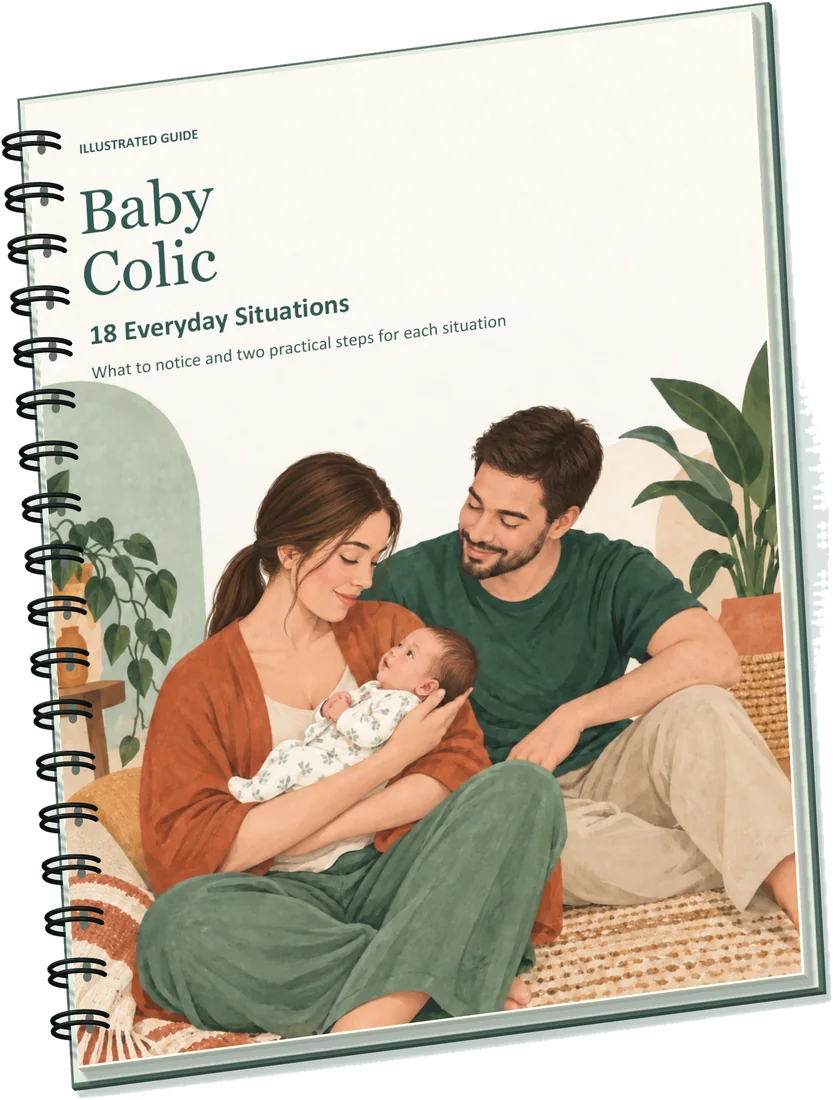
Cover of the Baby Colic illustrated guide.

Tonight's crying will blur into last night's. By the appointment, all of it will have turned into one sentence.

Write it down while it is happening, on a page that already tells you what to look at.

Eighteen everyday situations. Two practical steps each. Thirty pages. Twenty-nine sources you can check yourself.

CAD $19, and 7 days to ask Hotmart for a refund if it isn't what you expected.

  • Checkout by Hotmart
  • Digital download
  • 7-day refund

Questions

What do I get, and how does it arrive?

A PDF of 30 pages, 18 × 24 cm, Canadian English edition 1.0, plus a "3D book" version in HTML to read in a browser. It is a digital download through Hotmart. Nothing is shipped.

Will it tell me what is causing the crying?

No. Page 2: "Colic does not have 18 established causes." The numbers organize different situations — feeding, symptoms that may be mistaken for colic, and care decisions — and "They do not rank causes or severity."

Does it replace my baby's health care provider?

No. It is built to make that appointment better: page 25 is a diary of what you saw and what you did, and page 26 organizes feeding, symptoms noticed, products used and the questions you want to ask. Your notes are observations, not a diagnosis.

Does it give doses, teas or remedies?

No. Page 22: "This guide does not provide doses or tell you to stop a current prescription." Page 19: "Do not use tea, juice or water instead of milk to treat colic." Page 23: "This guide does not select a brand or dose or present probiotics as universal colic prevention."

Isn't all of this free online?

Much of it is, and we won't pretend otherwise. The sources are named on pages 27 to 29 and you can look them up yourself. In British Columbia, for example, the Period of PURPLE Crying is free and handed out through hospitals, funded by the provincial government (dontshake.ca/purple). What you are paying for here is the organizing: eighteen everyday scenes, one page each, what to notice, how to respond, two practical steps, and the sources printed on the page.

What if it isn't what I expected?

Request a refund through Hotmart within 7 days of your purchase. You don't need to explain why.